Congress passed the Indian Citizenship Act in 1924, but still left Native Peoples in Arizona and New Mexico from voting until 1948.
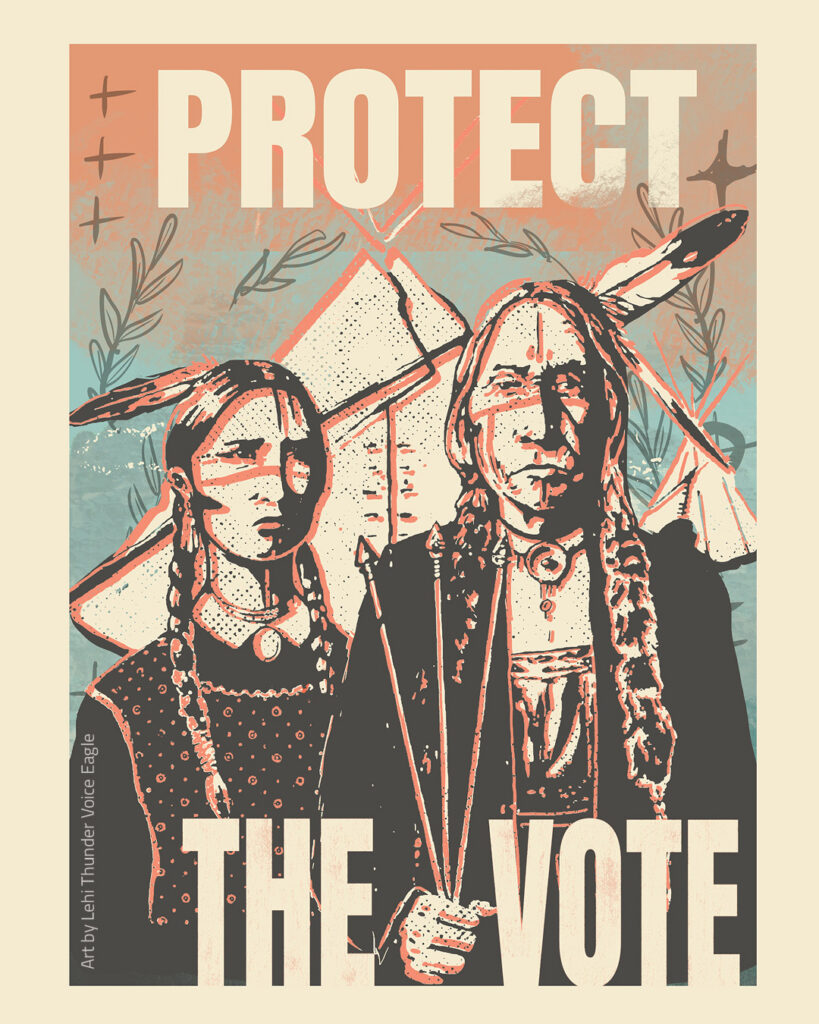
Lehi Thunder Voice Eagle’s Native American Gothic places America’s First people into the country’s most familiar portrait of itself. An Elder and Matriarch stand in the same pose as the Grant Wood’s farm couple. They fiercely wear braids, face paint, and are adorned with Eagle feathers–a symbol of respect and high esteem. A tipi stands behind them in place of the white farmhouse. The Elder holds three arrows where Woods’ farmer held a pitchfork, and he looks straight at the viewer.
Thunder Voice Eagle sets the record straight, reminding onlookers who was here first, creating a powerful version for this election campaign with words added: Protect the Vote.
Democracy is Indigenous to this land
Long before 1776, the Haudenosaunee Confederacy governed six nations under the Great Law of Peace. Nations kept their own councils and joined together on shared matters. Clan mothers chose leaders and could remove them. In 1744, the Onondaga leader Canassatego told colonial delegates at Lancaster to unite the way the Six Nations had. In 1988, Congress passed a resolution acknowledging the Confederacy’s influence on the U.S. Constitution. Tribal Nations across this continent have their own long traditions of council, consensus and accountability to the people. Democracy on this soil began with us, the Indigenous Peoples, and Tribal Nations still govern today.
Why we say Protect the Vote
These words are intentional. The vote belongs to everyone in this country, and Native Peoples have always been part of everyone. Tribal citizens are first citizens of the land, then citizens of their states, and of the United States, and are uniquely connected to all three when they go to the polls. This comes with the most unique interconnected responsibility in this land. When a country closes the only polling place on a reservation, or a state rejects Tribal IDs, or the mail is too slow for ballots to arrive in time, the damage permeates beyond Native voters and weakens the system as a whole. Native organizers drive voters to the polls, help connect them with registration, and help when a ballot goes missing, and the people they help include their non-Native neighbors. In protecting the vote, Native communities are protecting it for ALL of us.
What the research shows
Recent research found that two-thirds of Americans still call democracy the best form of government. More than half say it is going poorly in the U.S. Nearly half of those surveyed say ordinary people have real power to change things in their local community. Earlier research, found that 43% of Americans have never been invited or encouraged to take part in civic life.
Our relatives have been frustrated with national institutions for generations, and yet, we keep showing up when it matters. That is resilience, and it comes from each other. People take part when someone asks them, and they trust democracy more when they trust their neighbors.
It’s about all of us
A single vote does, in fact, matter. But that is not the destination–what lasts is a People who vote together, year after year, and look after each other’s right to do so. Native civic power is built that way, through tribal governments’ responsibility for their citizens on and off their reservations and through Native-led organizations that know voters by name. Grandparents bring grandchildren. Cousins call cousins. When one of us faces a barrier at the polls, we have each others’ backs and we show up to witness.
The Protect the Vote artwork is available to Native organizations and Tribal Nation on the Native Power Resources Hub. Election Day is November 3rd. Check your registration, make a plan, and bring a relative.
The Native Civic Power Initiative Table